
Are There Microplastics in Invisalign and Retainers? What You Should Know
Invisalign aligners aren’t made from one generic type of household plastic.
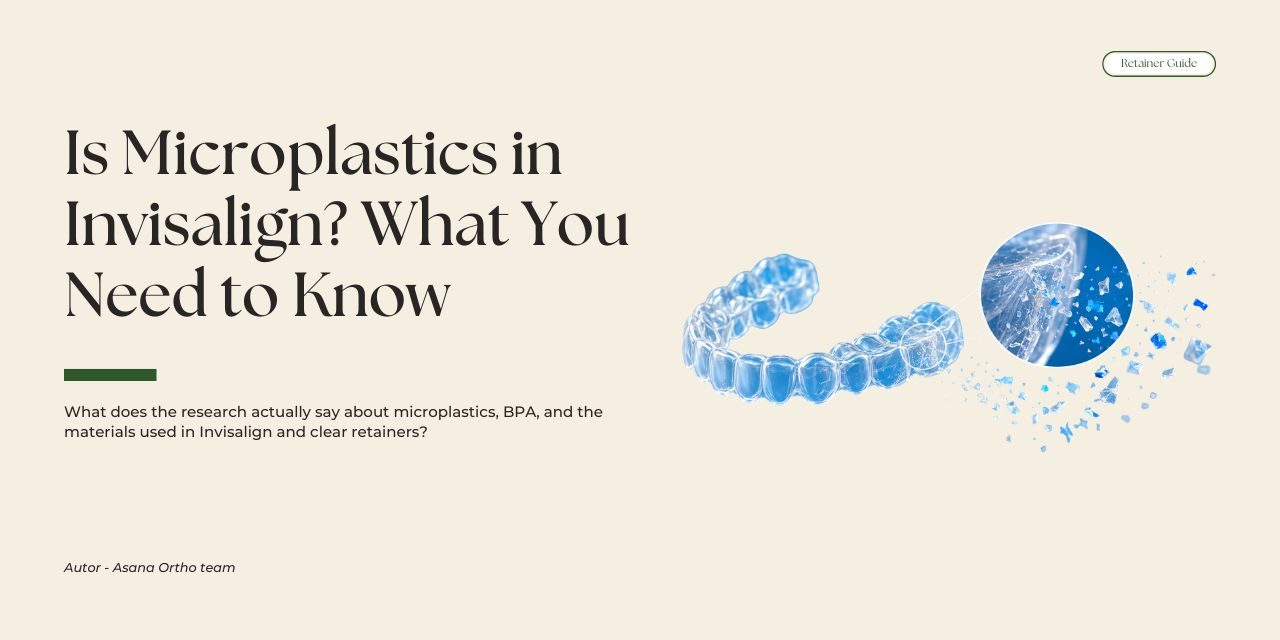
Clear aligners and retainers are made from polymer-based materials designed for intraoral orthodontic use.. Like other plastic products, these materials can experience wear and surface changes over time. Recent laboratory research has detected microplastic particles released from different types of clear aligners under simulated conditions. However, researchers are still studying what these particles mean for long-term human health.
In a nutshell: yes, clear orthodontic aligners can release microscopic plastic particles during use.
That includes Invisalign.
But there’s an important distinction between detecting microplastics and proving that wearing Invisalign or a clear retainer causes a health problem.
So, if you’re asking:
- Are there microplastics in retainers?
- Are there microplastics in Invisalign?
- Does Invisalign release more microplastics than a toothbrush?
- Does Invisalign contain BPA or other potentially harmful substances?
This article is the perfect breakdown for all your queries. Let’s break down what we actually know.
Are there Microplastics in Invisalign?
There is evidence that clear orthodontic aligners can release microplastic particles during use.
A 2023 laboratory study tested several clear aligner systems, including Invisalign, by placing aligners in artificial saliva and mechanically agitating them to simulate friction in the mouth. Researchers detected microplastic particles from the tested aligners. In that particular study, Invisalign had the lowest number of detected particles among the aligners tested, although the researchers were clear that the experiment was performed under controlled laboratory conditions rather than normal real-world use.
More recent research has continued to investigate this question.
A 2026 multidisciplinary in-vitro study tested ten different clear aligner systems and found that microplastic release increased between 7 and 14 days of simulated use. The researchers also found that the amount and characteristics of released particles varied depending on the material used. Importantly, they noted that the clinical significance of these findings remains unclear and that more research in people is needed.
So the most accurate answer is:
Yes, microplastic release from clear aligners has been demonstrated in laboratory studies. But we don’t currently have enough clinical evidence to say that wearing Invisalign exposes patients to a harmful level of microplastics.
What are Invisalign Aligners made of?
Invisalign aligners aren’t made from one generic type of household plastic.
According to Invisalign, the aligners are made using SmartTrack, a proprietary multi-layer material developed specifically for the Invisalign system. It is engineered to provide the flexibility and force characteristics needed to move teeth during treatment.
Each aligner is custom-made for your teeth and designed to be worn for a specific stage of treatment. Invisalign treatment involves changing aligners according to your orthodontist’s treatment plan.
And once active tooth movement is complete, you’ll typically move into a retention phase using a retainer to maintain your results.
If you’re considering Invisalign and want to understand the treatment itself, our guide on what to expect during your first Invisalign consultation walks through how your orthodontist evaluates your teeth, bite, treatment goals, and treatment options.
Are there Microplastics in Retainers?
Potentially, yes.
Clear retainers are also made from thermoplastic materials, so they can undergo wear and surface changes over time.
Research examining orthodontic aligners and transparent thermoplastic retainers has investigated issues including material degradation, chemical release, and biocompatibility. A systematic review found that the available evidence on the biological safety of these materials is mixed and that study methods vary considerably.
More recent research into dental materials also identifies clear aligners and other thermoplastic orthodontic appliances as potential sources of microscopic polymer particles through normal wear and degradation. However, researchers continue to emphasize that the actual health significance of this exposure isn’t yet established.
So if you wear a clear retainer every night, the question isn’t simply:
“Does this contain plastic?”
It does.
The more useful questions are:
What material is it made from? How is it manufactured? How much material is released during normal use? And does that amount create a meaningful health risk?
Those are the questions researchers are still working to answer.
Does Invisalign Release more Microplastics than my Toothbrush?
This is where things get interesting.
We don’t currently have enough standardized research to make a reliable apples-to-apples comparison between Invisalign and a toothbrush.
Why?
Because the studies use very different testing conditions.
A 2023 study investigating toothbrushes found evidence of microplastic release from toothbrushes, with estimates of thousands of particles released during daily use.
Another 2025 study examining toothbrushes and toothpaste estimated substantial annual microplastic release from commonly used oral-care products, although the researchers did not find evidence from their risk assessment that these products directly contributed to health risks at the levels studied.
Meanwhile, studies of clear aligners typically place aligners in artificial saliva and subject them to controlled mechanical agitation for a specified period before measuring released particles.
So you can’t simply compare:
“X particles from Invisalign” vs. “Y particles from a toothbrush”
and conclude that one is safer. The particles may differ in:
- Size
- Polymer type
- Shape
- Release mechanism
- Duration of exposure
- Testing conditions
- Amount actually swallowed
- Biological effects
Until researchers use standardized methods across both products, a direct numerical comparison would be misleading.
The Bigger Picture
Interestingly, you’re not only exposed to plastic from orthodontic appliances.
Toothbrushes, toothpaste packaging, dental floss, mouthwash containers, and other everyday products can also involve polymers.
A study of oral healthcare products available in India found microplastic contamination across several categories, with toothbrushes showing the highest particle counts among the products examined.
That doesn’t mean you should stop brushing your teeth.
It simply puts the Invisalign question into context.
The presence of microscopic plastic particles doesn’t automatically mean that a product is unsafe. Exposure level, material characteristics, route of exposure, and actual health effects all matter.
Does Invisalign Contain BPA?
This is another question where it’s important to separate what has been detected in some orthodontic materials from what has been demonstrated specifically for Invisalign.
BPA, or bisphenol A, is a chemical that has received significant attention because of its potential endocrine-disrupting effects.
Researchers have therefore studied whether BPA can leach from clear aligners and other thermoplastic orthodontic appliances.
The results have been inconsistent.
A systematic review of BPA release from clear aligner materials found that some studies detected BPA while others found no detectable BPA. The authors concluded that the available evidence was conflicting and generally low to very low quality.
Another systematic review covering clear aligners and transparent thermoplastic retainers similarly found that most in-vitro studies reported very low or undetectable BPA release, while one clinical trial reported higher salivary BPA levels. The authors concluded that the evidence was inconsistent and that additional clinical research is needed.
More recent laboratory research published in 2025 examined several aligner materials and found no BPA in any of the four samples tested after 72 hours, although BPS was detected in one material. The researchers also found that other compounds could leach from some materials, generally at low levels.
So rather than saying:
“Invisalign has BPA.”
or:
“Invisalign is completely free from every potentially concerning chemical.”
the scientifically responsible answer is:
Research on BPA and other chemical release from clear orthodontic materials is ongoing, and results vary depending on the material and testing method.
Does Invisalign Contain other Harmful Substances?
Clear aligners are polymers, and polymers can contain or potentially release various chemical compounds depending on how they’re manufactured.
Researchers have therefore studied more than just BPA.
One laboratory study examining different clear aligner systems detected several leachable organic compounds, although the amount and type varied between materials. Interestingly, the Invisalign system in that particular study had the lowest amount of leached chemicals among the four systems tested. None of the systems released detectable BPA in that experiment.
A newer 2025 study examining the biocompatibility of different aligner materials similarly found that the amount of leachable compounds varied between materials, with most release occurring during the first 24 hours. The researchers described the overall levels as generally low while noting that cumulative exposure deserves further consideration.
This is an important distinction.
“A chemical can be detected” does not automatically mean “the amount detected is harmful.”
Toxicology depends heavily on dose, exposure, route, duration, and the properties of the substance.
Should I Be Worried about Wearing Invisalign?
For most patients, this isn’t a reason to automatically avoid orthodontic treatment.
The current research does justify continued investigation into the materials used in clear aligners and retainers. Researchers have demonstrated microplastic release under laboratory conditions, and studies of chemical leaching have produced mixed findings.
But there is currently not enough evidence to conclude that normal Invisalign treatment causes a specific microplastic-related health problem in patients. Recent reviews specifically highlight the need for more real-world and long-term research.
It’s also worth remembering that every orthodontic treatment has a broader set of considerations.
The important questions include:
-
- Is orthodontic treatment appropriate for your teeth and bite?
- Is Invisalign suitable for the movements you need?
- Will you be able to wear the aligners as instructed?
- How will you maintain good oral hygiene?
- What type of retainer will you use afterward?
- What does your orthodontist recommend based on your individual case?
- If you’re deciding between braces and Invisalign, our guide on Braces or Invisalign: Which Is Better for My Case? explains some of the factors that go into that decision.
What about the Microplastics from Wearing Invisalign for 20–22 Hours a day?
This is a reasonable concern because Invisalign aligners are typically worn for most of the day during active treatment.
More wear time means more time for the material to be exposed to saliva, temperature changes, chewing forces, and mechanical friction.
Laboratory studies have found that microplastic release can increase with simulated wear time. A 2026 study, for example, found significantly greater microplastic release after 14 days compared with 7 days in its experimental setup.
But there’s an important catch:
Laboratory simulation isn’t the same thing as measuring what happens in a real patient’s mouth.
The study conditions, mechanical forces, saliva composition, temperature, cleaning practices, and individual behavior can all differ.
That’s why researchers are calling for additional in-vivo research before conclusions can be drawn about actual patient health risks.
Does Changing Invisalign Aligners Regularly make a Difference?
Invisalign treatment already involves replacing aligners according to a prescribed treatment schedule.
This means you’re generally not expected to wear the same active aligner indefinitely.
Interestingly, the 2026 laboratory study suggested that replacing clear aligners after seven days could potentially reduce microplastic release compared with longer simulated use. However, this was a laboratory finding, and it does not mean patients should independently change their Invisalign schedule.
Your aligner change schedule should always come from your orthodontist.
Changing trays more frequently than instructed can interfere with treatment because each aligner is designed to move your teeth according to a specific sequence.
If you’re curious about how long Invisalign treatment typically takes, our guide on How Long Does Invisalign Treatment Actually Take? explains why treatment time varies from patient to patient.
What Can I do to Reduce Unnecessary Exposure?
You don’t need to become obsessed with avoiding every piece of plastic.
Instead, focus on the things that actually make sense during orthodontic treatment.
1. Follow Your Prescribed Wear and Change Schedule
Don’t wear an aligner longer than instructed simply because it still looks fine.
At the same time, don’t change aligners earlier than recommended without speaking with your orthodontist.
2. Keep Your Aligners Clean
Follow your orthodontist’s cleaning instructions and avoid practices that could damage or distort the material.
3. Don’t Eat With Your Aligners Unless Specifically Instructed
Invisalign is generally designed to be removed for eating and drinking anything other than water.
That helps protect the aligners and makes maintaining good oral hygiene easier.
4. Replace Damaged Aligners
If an aligner becomes cracked, badly scratched, warped, or damaged, contact your orthodontist.
Don’t continue using a damaged appliance simply because you don’t want to waste it.
5. Keep your Follow-Up Appointments
Your orthodontist isn’t just checking whether your teeth are moving.
They’re also checking the condition of your teeth, gums, bite, and orthodontic appliances.
If you have concerns about your aligner material or any symptoms you’re experiencing, that’s the right time to bring them up.
What About Retainers After Invisalign?
Once your Invisalign treatment is complete, you’ll typically transition to a retainer to help maintain your results.
Invisalign notes that patients need retainers after treatment, and some patients may receive Vivera retainers or another retainer option depending on their doctor’s recommendation.
That brings up another important point:
You don’t necessarily have to keep wearing active Invisalign aligners indefinitely.
Your orthodontist will determine the appropriate retention strategy after your teeth have reached their planned positions.
If you’re wondering how long you actually need to wear a retainer, or what happens when an old retainer stops fitting, we’ve covered that in detail in our guide to when to wear retainers and what to do when your old retainer no longer fits.
Is Invisalign Worth It If I’m Concerned About Microplastics?
That’s ultimately a personal decision, but it’s useful to put the concern into perspective.
Invisalign is one of several orthodontic treatment approaches.
Clear aligners offer certain practical advantages, including removability and the ability to take them out for eating and oral hygiene. Traditional braces use a different set of materials and don’t involve removable plastic aligners.
The right treatment depends on your orthodontic needs, not simply on whether one appliance contains plastic.
If you’re comparing the overall value of Invisalign, including treatment planning, professional monitoring, convenience, and retention, our article Is Invisalign Worth It? Here’s What You’re Really Paying For goes deeper into the broader investment.
The Bottom Line: What Do We Actually Know?
Here’s the short version.
1. Are there microplastics associated with clear aligners?
Yes. Laboratory studies have detected microplastic particles released from different clear aligner materials, including Invisalign.
2. Does that mean Invisalign is harmful?
Not necessarily. The clinical significance of the detected particles and their long-term health implications are still being investigated.
3. Does Invisalign contain BPA?
Research on BPA release from clear aligner materials has produced inconsistent findings. Some studies detected BPA from certain materials, while others did not.
4. Does Invisalign release more microplastics than a toothbrush?
We don’t have a reliable apples-to-apples comparison. Both toothbrushes and clear aligners have been studied as potential sources of microplastic exposure, but the testing methods and conditions are too different to establish that one exposes you to more than the other.
5. Should you stop using Invisalign because of microplastics?
Current research does not establish that normal Invisalign treatment causes a specific microplastic-related health problem. If you have concerns, discuss them with your orthodontist and consider the full range of treatment options available for your particular case.
Ready to Talk Through Your Invisalign Options?
It’s completely reasonable to have questions about what you’re putting in your mouth, especially when you’re wearing an orthodontic appliance for 20–22 hours a day.
The science around microplastics and orthodontic materials is evolving. New studies are continuing to investigate how different aligner materials behave during use, what compounds they may release, and whether those exposures have meaningful health consequences.
At Asana Ortho, your treatment plan should start with your teeth, bite, goals, and overall oral health.
If you’re considering Invisalign in Berkeley, a consultation gives you the opportunity to ask questions about the materials, treatment process, expected wear time, alternatives, and retention before making a decision.
You can also start by reading our guide on what to expect during your first Invisalign consultation.
Have questions about Invisalign, braces, or retainers? Talk to an orthodontist and get answers based on your specific smile rather than generic advice from the internet.


Reason Behind 1000+ Smiles in Berkeley
Invisalign in Berkeley at Asana Ortho is led by Dr. Nourah, a Key Opinion Leader for Invisalign and one of the top 0.1% Invisalign providers globally, giving you access to expert-level planning and results.
- Detailed consultation before we even sit you down for a treatment
- Quick turnaround time, no needless treatment walk-ins
- Customized braces and aligners for which stage your teeth are in
- You can also avail teeth cleaning in Albany
- Peace of mind with virtual and remote care options
Why Asana Ortho
Invisalign Care for Berkeley, Albany, El Cerrito, and the East Bay
At Asana Ortho, your treatment is led by Dr. Nourah, a board-certified orthodontist and Diamond Plus Invisalign Provider. Her experience includes treating children, teens, and adults with clear aligners and braces—from straightforward spacing or crowding to more complex bite concerns. Every recommendation begins with an in-person evaluation of your teeth, bite, goals, and lifestyle.
Our practice builds on 30 years of serving the community, with a refreshed approach centered on personalized planning, clear communication, and orthodontic care tailored to real life in the East Bay.
When comparing orthodontists, look beyond marketing labels. Ask who will diagnose your bite, who will oversee your progress, what alternatives are offered, what is included in your fee, and what support you will receive after treatment.
Ready to Learn What Is Possible for Your Smile?
Schedule your complimentary, in-person Invisalign consultation at Asana Ortho. We will listen to your goals, evaluate your smile and bite, and help you understand your options—so you can choose your next step with confidence.