
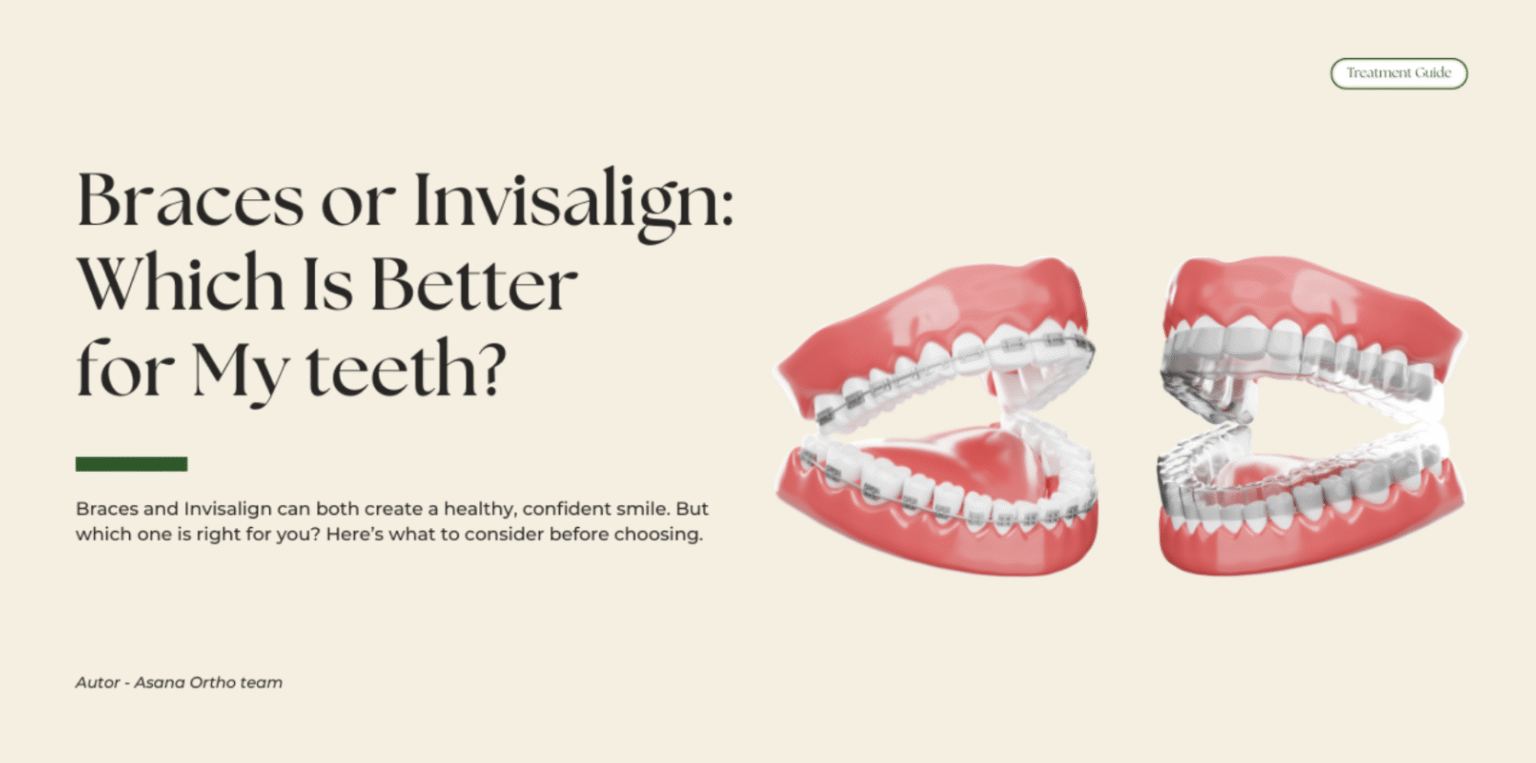
Braces or Invisalign: Which Is Better for My Case?
Braces and Invisalign can both create a healthy, confident smile, but the best option depends on your bite, the tooth movements needed, your lifestyle, and how consistently you can follow treatment instructions.
Braces and Invisalign can both create a healthy, confident smile, but the best option depends on your bite, the tooth movements needed, your lifestyle, and how consistently you can follow treatment instructions.
At Asana Ortho, Dr. Nourah will evaluate your smile and bite during a complimentary, in-person consultation and explain whether braces, Invisalign clear aligners, or another approach is the most predictable choice for you.
Braces vs. Invisalign: What Is the Difference?
Both braces and clear aligners use gentle, controlled force to move teeth over time. The main difference is how they deliver that force.
Braces use brackets and wires that remain attached to your teeth throughout treatment. Because they work around the clock, braces can be especially helpful for complex tooth movements and bite corrections.
Invisalign clear aligners are a series of custom-made, removable trays that fit closely over your teeth. You switch to new aligners as directed, with each set moving your teeth a small amount toward the planned result.
Neither option is automatically “better.” The right choice is the one that can achieve your treatment goals safely, predictably, and in a way that works with your daily life. The American Association of Orthodontists notes that braces can treat most orthodontic concerns, while clear aligners can effectively treat many cases but require consistent wear and are not appropriate for every patient.
Is Invisalign or Braces More Effective?
For the right patient and the right diagnosis, both braces and Invisalign can create excellent results.
Clear aligners can be effective for many concerns, including crowding, spacing, certain bite corrections, and teeth that have shifted after earlier orthodontic treatment. Braces can offer more direct control for some complex movements, including severe crowding, significant rotations, difficult bite corrections, and cases that require continuous force without relying on removable aligners.
Research comparing clear aligners and braces found that both can effectively treat malocclusion. In that review, aligners showed advantages in selected tooth movements and treatment duration, while braces provided stronger control for occlusal contacts, tooth torque, transverse changes, and retention in the included studies.
Ready to find out what's right for you?
At Asana Ortho, we do not choose treatment based only on appearance or convenience. Dr. Nourah will assess your teeth, bite, jaw relationship, oral health, and long-term goals before recommending the approach that fits your case. Book Your Free Consultation.
Who May Be a Good Candidate for Invisalign?
Invisalign may be a great fit if you:
- Want a discreet orthodontic option for school, work, photos, or events
- Have mild to moderate crowding or spacing
- Have experienced shifting after previous braces
- Can wear aligners consistently for about 22 hours each day
- Can remove aligners for meals and put them back in afterward
- Are prepared to brush before reinserting aligners
- Want to avoid food restrictions associated with braces
Invisalign requires daily responsibility. Aligners work only when they are worn as prescribed. Because they are removable, they can be misplaced, left out too long, or damaged if they are not stored safely in their case.
Ready to Find Out Which Option Fits Your Smile?
Schedule a complimentary, in-person orthodontic consultation at Asana Ortho. We will evaluate your smile and bite, answer your questions honestly, and help you understand whether braces or Invisalign is the best fit for your goals and lifestyle.
This article is for general educational purposes only and is not medical advice. Orthodontic recommendations, timelines, treatment costs, and outcomes vary by patient. An in-person evaluation with a licensed orthodontist is needed to determine the right treatment for your individual needs.
Frequently Asked Questions
Is Invisalign better than braces?
Are braces more effective than Invisalign?
Braces offer strong control for a wide range of orthodontic concerns, especially more complex cases. Invisalign can also be highly effective when it is appropriate for the patient and worn consistently. A clinical evaluation is the only way to know which approach is right for you
Is Invisalign more expensive than braces?
The cost of either treatment depends primarily on the complexity of the case, expected treatment length, and the services included in your treatment plan. We will review your personalized fee and payment options at your consultation.
Can I eat anything with Invisalign?
What if I'm not a candidate for Invisalign?
At Asana Ortho we take care to explain in detail why something like severe bite issues, complex rotations, etc., might make you a less ideal client for Invisalign, and recommend alternatives like traditional braces or hybrid approaches
Can I play sports with braces or Invisalign?
What if I lose an Invisalign aligner?
Do I need retainers after braces or Invisalign?
Yes. Retainers are essential after both braces and Invisalign. Teeth can shift over time, so a personalized retention plan helps protect your new smile after active treatment ends.