
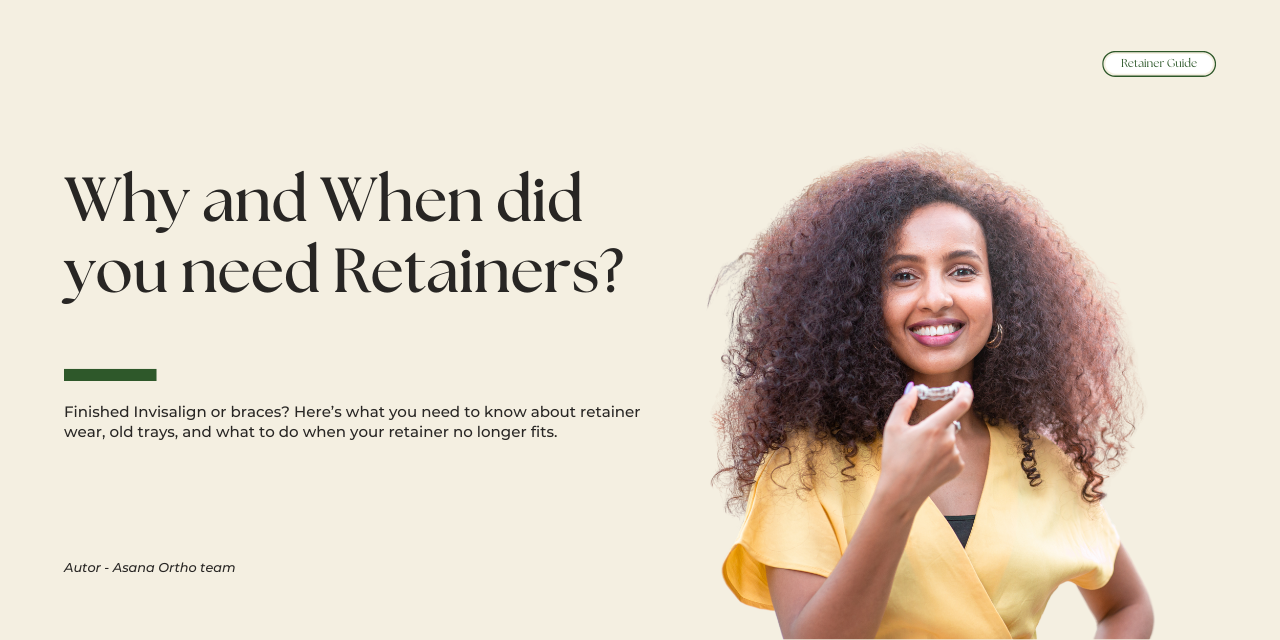
When Should You Wear a Retainer? What to Do If It No Longer Fits
Orthodontic treatment moves teeth into healthier, more balanced positions. However, teeth are not permanently locked in place when active treatment ends.
Finishing Invisalign or braces is a major milestone, but keeping your result requires retention.
Retainers hold your teeth in their planned positions while your bite and surrounding tissues adapt. Over time, teeth can continue to shift naturally, which is why most people need some form of retainer wear long term.
If you lose your retainer, it’s cracked, feels too tight, or no longer fits, do not panic, and do not force it. The right next step depends on how much your teeth have moved.
Quick Answer
-
- Wear your retainer exactly as instructed by your orthodontist.
-
- Many patients wear retainers more consistently at first and later transition to nighttime wear.
-
- Long-term retainer use is usually needed to protect orthodontic results.
-
- If your retainer does not fit fully, hurts, is warped, or is cracked, stop trying to force it and contact an orthodontist.
-
- An old Invisalign tray is not automatically a long-term replacement for a professionally made retainer.
Why Retainers Matter After Invisalign or Braces
Orthodontic treatment moves teeth into healthier, more balanced positions. However, teeth are not permanently locked in place when active treatment ends.
Your teeth are supported by bone, ligaments, and surrounding tissues that continue adapting after braces or aligners. Even years later, natural changes in the mouth, biting forces, growth, and aging can affect tooth position.
Without consistent retainer wear, you may notice:
-
- Front teeth becoming crowded or rotated again
-
- Small spaces reopening
-
- Teeth that no longer meet the same way
-
- A retainer that becomes tight or stops fitting
-
- A smile that slowly changes from the result you worked hard to achieve
Retainers are not an optional “extra” after treatment. They are the maintenance plan for your orthodontic result.
When Should I Wear My Retainer?
Your personal instructions from your orthodontist always come first.
Many patients begin with more frequent retainer wear after treatment and later transition to nighttime wear. However, the right plan depends on your original tooth positions, bite correction, treatment type, age, risk of tooth movement, and whether you have a fixed retainer.
A typical retention plan may look like this:
| Stage | What may be recommended |
| Just after braces or Invisalign | More consistent removable-retainer wear, with removal for meals, brushing, and cleaning |
| After the early retention phase | Transitioning toward nighttime wear, if your orthodontist confirms it is appropriate |
| Long term | Ongoing nighttime or other retainer wear to help maintain alignment |
Long term does not necessarily mean wearing a removable retainer all day forever. It means retention should remain part of your routine for as long as you want to maintain your orthodontic result.
What Type of Retainer Do I Need?
The best retainer depends on your teeth, bite, and risk of shifting. Your orthodontist may recommend one type or a combination.
| Retainer type | What it is | Common role |
| Clear removable retainer | A transparent, custom-made appliance that fits over the teeth | Holds teeth in position and is commonly worn at night |
| Hawley retainer | A removable acrylic-and-wire retainer | A durable option that can be adjusted in some situations |
| Fixed or bonded retainer | A thin wire bonded behind certain teeth | Provides continuous support, often for lower front teeth |
| Combined retention | A fixed retainer plus a removable retainer | May be used when long-term stability needs extra support |
A bonded retainer does not always replace the need for a removable retainer. It only holds the teeth it is attached to, and it still needs periodic checks.
How Do I Get a New Retainer?
A new retainer should be based on your current orthodontic situation, not simply ordered without checking whether your teeth have moved.
1. Your Teeth Are Evaluated
If your retainer is lost, broken, loose, or no longer fits, the first question is whether your teeth are still in the intended position.
If they are, a new retainer may be all you need. If they have shifted, a new retainer made from that shifted position may simply hold the movement rather than correct it.
2. A Digital Scan Is Taken
Your orthodontic team may use a digital scan to create a precise model of your teeth. This can be used to fabricate a new custom retainer and determine whether it should maintain your current alignment or follow a different treatment plan.
3. Your Retainer Is Made and Checked
Your new retainer should fit completely, comfortably, and securely. Tell your orthodontic team if it rocks, feels uneven, causes sharp pressure, or does not fully seat.
At Asana Ortho, retainer decisions begin with an in-person evaluation when there is concern about shifting or fit. This helps determine whether you need a new retainer, an adjustment, or a limited orthodontic solution before making a new long-term appliance.
Can I Use My Old Invisalign Trays as Retainers?
Not really.
During Invisalign treatment, every aligner is designed for a specific stage of tooth movement. A dedicated retainer is designed to maintain your final result after active treatment ends.
Your last Invisalign aligner may be useful as a short-term temporary option only if your orthodontist specifically tells you to use it. However, an older aligner from earlier in treatment should not be used as a DIY retainer. It may not match your current tooth positions and could apply unwanted pressure.
Use this simple guide:
| Situation | What to do |
| Your final Invisalign aligner still fits | Contact your orthodontist and ask whether you should use it temporarily while a new retainer is made |
| You only have an older aligner from an earlier stage | Do not use it as a retainer without professional guidance |
| Any aligner does not fit fully | Do not force it |
What If My Retainer Does Not Fit Anymore?
A retainer that does not fit is often a sign that your teeth have moved. This does not automatically mean you need braces or Invisalign again—but it does mean you should not ignore it.
If Your Retainer Is Slightly Snug
A mild feeling of snugness can happen, particularly if you missed a night or two. However, do not decide on your own that a tight retainer is safe to force into place.
Contact your orthodontist if the retainer feels significantly tighter than usual, causes pain, feels uneven, or does not sit fully over your teeth.
If Your Retainer Will Not Fully Seat
Do not bite down on it, force it with your hands, or wear it only halfway seated.
A poorly fitting retainer may be warped, damaged, or no longer match the position of your teeth. An orthodontist can determine whether the right solution is a replacement retainer or limited treatment to correct tooth movement.
Can a Retainer Move My Teeth Back?
A retainer’s main job is to hold teeth in position, not to make major tooth movements.
If your retainer still fits comfortably and your orthodontist advises you to resume wear, it may help maintain your current alignment. But if your teeth have noticeably shifted or the appliance no longer seats properly, trying to use it as a tooth-moving device can be uncomfortable and unpredictable.
Depending on your evaluation, the right path may be:
-
- A new retainer, if your teeth remain in an acceptable position
-
- An adjusted or replacement appliance
-
- Limited clear-aligner treatment for minor relapse
-
- Comprehensive orthodontic treatment if the movement is more significant
The earlier you address a retainer problem, the more options you may have.
Do I Need Braces or Invisalign Again to Get a New Retainer?
Not necessarily.
If your teeth have stayed stable, you may simply need a new retainer made from a fresh scan. Many people need replacement retainers because theirs were lost, damaged, worn out, or warped, not because they need treatment again.
However, if your teeth have moved and your goal is to return them to their former positions, making a new retainer alone will not accomplish that. A retainer made over shifted teeth is designed to hold those teeth where they are now.
An orthodontic evaluation helps determine whether you need:
-
- A replacement retainer
-
- A minor correction before retention
-
- A more comprehensive orthodontic plan
How Often Should I Replace My Retainer?
There is no fixed expiration date for every retainer. Its lifespan depends on the material, how often it is worn, teeth grinding, cleaning habits, heat exposure, and how carefully it is stored.
Contact your orthodontist if your retainer is:
-
- Cracked, split, or broken
-
- Warped from heat
-
- Loose, rough, or significantly worn
-
- Discolored or difficult to clean
-
- No longer fitting fully
-
- Lost
Keep retainers in their case when they are not in your mouth. Avoid leaving them loose in a napkin, pocket, car, or near pets.
What Should I Do Right Now?
| Your situation | Best next step |
| Retainer fits comfortably | Keep wearing it exactly as directed |
| Retainer feels slightly tighter than usual | Contact your orthodontist for personalized guidance before forcing it |
| Retainer will not fully seat | Stop trying to fit it and arrange an orthodontic evaluation |
| Retainer is cracked, warped, or broken | Do not keep wearing it; contact your orthodontist |
| Retainer is lost | Contact your orthodontic office promptly to discuss a new scan and replacement |
| Teeth have visibly shifted | Book an orthodontic evaluation to determine whether a new retainer or a limited correction is appropriate |
| You want a backup set | Ask about ordering additional custom retainers before you need them |
Retainers at Asana Ortho
At Asana Ortho, retention is treated as part of your orthodontic care, not an afterthought.
Dr. Nourah Abdul Kader, DMD, MS, is a board-certified orthodontist and Diamond Plus Invisalign Provider. She evaluates your current tooth position, bite, and retention needs before recommending the right next step.
For patients in Albany, Berkeley, El Cerrito, and the East Bay, we can help determine whether you need a replacement retainer, a fresh scan, a repair, or an orthodontic solution for teeth that have shifted.
If you want to purchase new custom retainers or create a backup plan for long-term smile maintenance, MyCA can help make retainer care simpler. However, if your retainer no longer fits or your teeth have shifted, begin with an orthodontic evaluation rather than ordering a replacement without professional guidance.
The Bottom Line
Retainers protect the time, effort, and investment you made in your smile.
Wear your retainer as instructed. Keep it clean and protected. Replace it when it is worn, warped, broken, or lost. If it no longer fits, do not force it, get professional guidance as soon as possible.
A new retainer may be a simple solution. If your teeth have shifted, early evaluation can help you understand whether a small correction or another treatment approach is needed before creating a new long-term retainer.
Ready to Protect Your Smile?
If you have lost a retainer, your old retainer no longer fits, or you want a new custom set, schedule a complimentary, in-person orthodontic evaluation at Asana Ortho in Albany.
We will assess your current smile, explain your options clearly, and help you choose the right next step to protect your orthodontic result.
Book your in-person consultation with Asana Ortho
This article is for general educational purposes and does not replace personalized orthodontic advice. Retainer type, wear schedule, replacement needs, and treatment recommendations vary by patient. If your retainer is painful, damaged, warped, or does not fit, contact a licensed orthodontist for an in-person evaluation.