
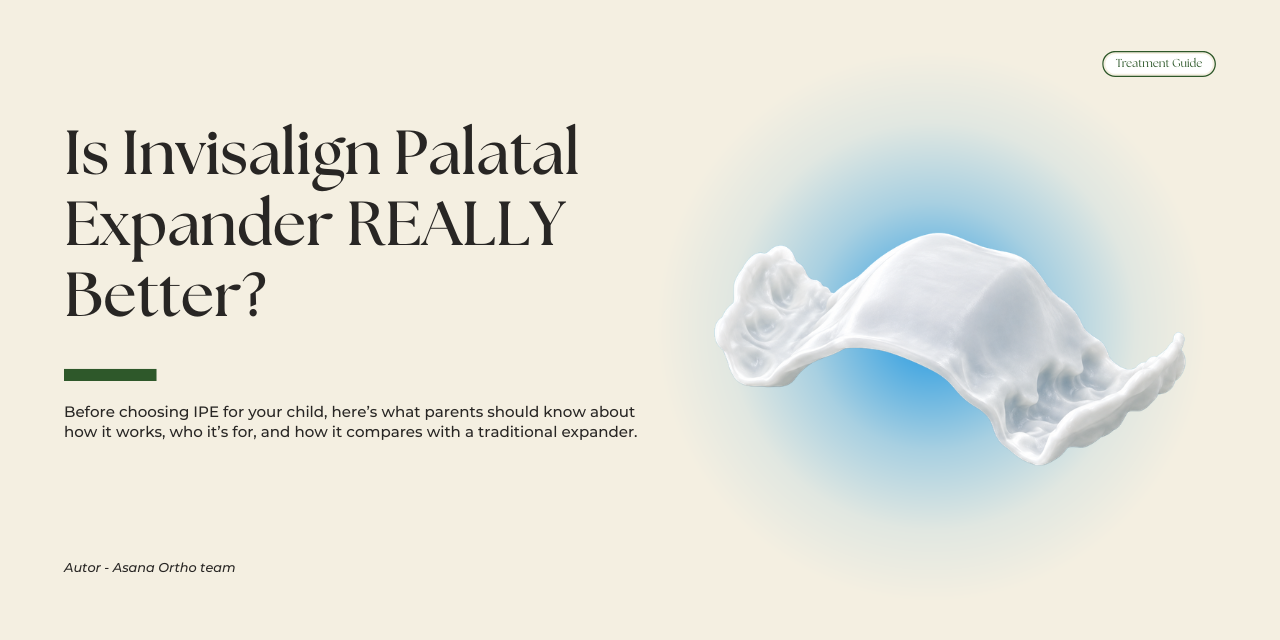
What Is the Invisalign Palatal Expander (IPE)? Is It Better Than a Fixed Metal Expander?
The Invisalign Palatal Expander (IPE) is a newer type of orthodontic appliance designed to expand the upper jaw in growing children.
Got only 15 seconds? Here’s a quick summary
- The Invisalign Palatal Expander (IPE) is a removable orthodontic appliance designed to gradually widen a child’s upper jaw when additional transverse width is needed.
- Unlike a traditional fixed metal expander such as a Hyrax, the IPE is made from custom-designed, 3D-printed material and can be removed for brushing and flossing.
- IPE is not automatically better than a fixed metal expander. The right appliance depends on your child’s age, growth stage, amount and type of expansion needed, teeth available for anchorage, and how predictable the orthodontist needs the expansion to be.
- A child may be a candidate for IPE if they have a developing upper jaw that needs expansion and enough erupted teeth to securely support the appliance. Your orthodontist needs to evaluate the child’s bite, teeth, growth, and the amount of expansion required.
- Because IPE is removable, losing an expander is possible. Contact your orthodontist rather than trying to repair or replace it yourself.
What is an Invisalign Palatal Expander?
The Invisalign Palatal Expander (IPE) is a newer type of orthodontic appliance designed to expand the upper jaw in growing children.
A traditional palatal expander is typically a fixed appliance attached to the upper teeth. It uses a mechanical mechanism—often a screw—that is activated according to the orthodontist’s treatment plan.
The IPE takes a different approach.
It consists of a series of custom-designed, 3D-printed expanders that fit over the child’s upper posterior teeth. Each expander provides a gradual amount of activation, with multiple expanders used sequentially when additional expansion is required.
The system also includes a Palatal Holder for the retention phase after active expansion.
In other words, the treatment isn’t simply:
-
- Put in expander
-
- Widen the palate
-
- Remove it.
There is an active expansion phase followed by a retention phase designed to maintain the expansion that was achieved.
2. Why Would a Child Need a Palatal Expander?
A palatal expander may be recommended when the upper jaw is too narrow relative to the lower jaw.
This is commonly referred to as a transverse maxillary deficiency.
A narrow upper jaw can be associated with problems such as:
- Posterior crossbite
- Dental crowding
- A narrow upper dental arch
- Asymmetrical bite relationships
- Insufficient transverse width between the upper and lower teeth
- The exact reason for expansion varies from child to child.
That’s why an orthodontist shouldn’t choose an expander simply because one appliance is newer, more comfortable, or more convenient.
The first question is:
Does your child actually need maxillary expansion, and if so, how much?
That requires an orthodontic evaluation.
3. How Does the Invisalign Palatal Expander Work?
The IPE works through a sequence of custom expanders.
Each expander provides a controlled amount of activation, and the child progresses through the series according to the orthodontist’s prescribed protocol.
A recent clinical study describes the IPE as a series of 3D-printed Nylon 12 expanders designed to conform to the shape of the palate and engage the posterior teeth. The active expansion phase in that study lasted approximately one month, although the exact treatment protocol can vary according to the individual case.
The important concept is gradual, controlled expansion.
The goal isn’t simply to move the teeth outward.
For appropriate growing patients, the objective can include widening the upper jaw and opening the midpalatal suture.
A 2026 pilot study found midpalatal suture opening in all 15 patients treated with IPE in its final IPE group, with skeletal and occlusal outcomes broadly comparable to those seen with a Hyrax rapid palatal expander.
4. Is the Invisalign Palatal Expander FDA-Cleared?
Yes.
The Invisalign Palatal Expander System is FDA-cleared for its intended use.
Invisalign describes it as a removable palatal expander and cites a multi-site U.S. IDE clinical study involving 29 subjects between ages 7 and 10 as part of the evidence supporting the system.
But there’s an important distinction:
Here FDA-cleared does not mean “studied for decades.”
Traditional palatal expanders such as the Hyrax have been used and studied for many years.
The IPE is considerably newer.
So if a parent asks:
“Is IPE well tested?”
The most accurate answer is:
There is clinical evidence supporting its use, but the research base is still much smaller and newer than the evidence base for conventional palatal expanders.
That’s an important distinction.
5. Is Invisalign Palatal Expander Well Tested?
The Short Answer: It Has Evidence, But It Is Still a Newer Technology
There are now several sources of clinical evidence relevant to the broader use of Invisalign-based expansion and the IPE specifically.
Invisalign reports data from its U.S. IDE clinical study involving 29 children ages 7–10.
More recently, a peer-reviewed 2026 pilot study directly compared IPE with a Hyrax rapid palatal expander.
The study included 30 patients between ages 7 and 18, with 15 treated with IPE and 15 with Hyrax.
The researchers found:
-
- Midpalatal suture opening with IPE
-
- Comparable radiographic outcomes between the groups
-
- Comparable theoretical expansion after accounting for activations
-
- Slightly lower expansion magnitude with IPE
-
- A more gradual and controlled expansion pattern with IPE
-
- No statistically significant difference in the side effects assessed by questionnaire
That’s encouraging.
But there is an important limitation.
It was a pilot study with only 30 analyzed patients.
The authors themselves concluded that additional studies with larger samples and longer follow-up are needed.
So we would not describe IPE as having the same depth of long-term evidence as traditional expanders.
What Does That Mean for Parents?
It means you don’t need to dismiss IPE because it’s new.
But you also shouldn’t assume that “newer” automatically means “better.”
A good orthodontist should explain:
-
- Why your child needs expansion
-
- How much expansion is needed
-
- What type of expansion is required
-
- Which appliance is being recommended
-
- Why that appliance fits your child’s particular case
6. Is IPE Better Than a Fixed Metal Expander?
There isn’t a simple yes-or-no answer.
IPE can be better for some children and conventional fixed expansion can be better for others.
The two appliances have different strengths.
| Consideration | Invisalign Palatal Expander | Fixed Metal Expander |
| Removable | Yes | Generally no |
| Oral hygiene | Easier to remove for brushing/flossing | Requires cleaning around fixed appliance |
| Appearance | Less visible | More visible |
| Metal components | No traditional metal screw/wire design | Commonly uses metal components |
| Patient cooperation | Important | Less dependent on remembering to wear it |
| Expansion protocol | Gradual, sequential appliances | Mechanical activation according to appliance design |
| Evidence base | Newer | Much longer history of clinical use |
| Best choice | Depends on the child’s diagnosis | Depends on the child’s diagnosis |
The key issue is that these appliances should not be treated as interchangeable.
Recent research comparing Invisalign-based treatment with rapid palatal expansion has found measurable expansion with both approaches, but differences in the type and magnitude of expansion. A randomized clinical trial found trends favoring rapid maxillary expansion across several measured outcomes, while a more recent comparison concluded that appliance selection should depend on the severity and nature of the transverse deficiency.
So the better question is not:
“Which appliance is more advanced?”
It’s:
“Which appliance can give my child the type of expansion they actually need?”
7. What Are the Advantages of Invisalign Palatal Expander?
There are several reasons an orthodontist may consider IPE for an appropriate child.
7.1 It’s Removable
One of the biggest differences is that the IPE can be removed.
That can make brushing and flossing easier compared with a fixed appliance. Invisalign specifically highlights removability as an advantage of the system.
For parents, this can make maintaining oral hygiene simpler.
For children, however, removability comes with a responsibility:
They have to wear it as prescribed.
7.2 It’s Custom Designed
The IPE is digitally designed around the child’s anatomy and produced using 3D printing.
This allows the appliance to be customized rather than using one generic appliance size.
7.3 No Traditional Metal Screw in the Mouth
For families who are concerned about the appearance or feel of a traditional expander, the IPE offers a different experience.
It is designed to fit over the upper posterior teeth without the conventional metal framework associated with many fixed expanders.
7.4 Easier Oral Hygiene
Because the appliance can be removed, children can brush and floss without having to clean around a permanently attached expander.
That doesn’t mean oral hygiene becomes optional.
It means the appliance itself may be easier to work around.
8. What Are the Disadvantages of IPE?
IPE isn’t perfect.
The biggest consideration is compliance.
A fixed expander is attached to the teeth.
A removable expander can be taken out.
That means a child can forget it, misplace it, remove it too often, or simply decide not to wear it.
For a child who struggles with consistently wearing removable orthodontic appliances, a fixed appliance may sometimes be the more predictable choice.
There is also the question of evidence.
Traditional expanders have a much longer history of clinical use and research.
IPE has promising evidence, but the long-term evidence base is still developing.
Finally, not every type or severity of transverse problem is necessarily appropriate for a removable expander.
That’s why candidacy matters.
9. How Do I Know If My Child Is a Candidate for IPE?
This is one of the most important questions to ask.
Your child may be considered for IPE when they are still growing and have an orthodontic problem that can appropriately be addressed through maxillary expansion.
The clinical evidence for IPE includes growing patients in the mixed-dentition stage. The recent comparative pilot study included patients ages 7–18, while Invisalign’s cited U.S. IDE study involved children ages 7–10.
But age alone doesn’t determine candidacy.
Your orthodontist will typically need to consider:
9.1 Your Child’s Growth Stage
Expansion is closely related to growth and development.
The appropriate timing depends on the individual child rather than simply their birthday.
9.2 The Width of the Upper Jaw
Your orthodontist needs to determine whether the upper jaw is actually too narrow and how significant the discrepancy is.
9.3 The Type of Crossbite or Bite Problem
A child’s bite can be narrow for different reasons.
Some problems are primarily skeletal.
Others are primarily dental.
Some are a combination.
That distinction matters when choosing an appliance.
9.4 Available Teeth for Anchorage
The IPE needs sufficient tooth structure and appropriate posterior teeth for the appliance to engage.
The recent IPE pilot study required specific erupted or erupting posterior teeth and adequate clinical crown height for anchorage.
9.5 Your Child’s Ability to Cooperate
This is a big one.
A removable appliance only works as planned if it is worn as prescribed.
Your orthodontist may therefore consider your child’s age, maturity, habits, and ability to follow instructions.
10. What Happens During an IPE Consultation?
Your orthodontist shouldn’t simply look at your child’s teeth and say:
“Let’s put in an expander.”
A proper evaluation should first establish whether expansion is actually necessary.
The consultation may involve:
-
- Reviewing your child’s dental and orthodontic history
-
- Examining the bite
-
- Assessing upper and lower jaw relationships
-
- Looking at the width of the upper arch
-
- Evaluating available teeth for appliance support
-
- Taking digital scans or impressions
-
- Taking photographs
-
- Using X-rays or other diagnostic records when clinically indicated
-
- Discussing growth and treatment timing
-
- Comparing appliance options
-
- Explaining expected treatment and retention
The goal is to understand why expansion is needed before deciding how to perform it.
If you’re preparing for an orthodontic consultation, you can also read our guide on What to Expect During Your First Invisalign Consultation.
11. What Happens If My Child Loses Their Invisalign Palatal Expander?
This is one of the biggest practical differences between a removable and fixed appliance.
Yes, an IPE can be lost.
And if it happens, don’t panic.
But don’t simply ignore it either.
Step 1: Contact Your Orthodontist
Tell the office that the expander has been lost.
Let them know:
-
- When it was lost
-
- Which expander your child was wearing
-
- Approximately how long it had been missing
-
- Whether you still have the previous or next appliance
Step 2: Don’t Guess Which Appliance to Wear
It may be tempting to simply move to the next expander.
Don’t assume that’s appropriate.
Your orthodontist may want your child to continue with a previous appliance, move to another one, or have a replacement made.
The correct choice depends on where your child is in the expansion sequence.
Step 3: Don’t Try to Repair It Yourself
Don’t use glue, heat, household adhesives, or DIY modifications.
If the appliance is damaged or lost, let your orthodontic team determine the appropriate next step.
Step 4: Expect That a Replacement May Be Needed
Because IPE is custom-made, replacing a lost appliance isn’t the same as grabbing a generic appliance off a shelf.
Your orthodontist will determine what replacement is appropriate.
12. What If My Child Loses the IPE for Several Days?
The longer the appliance is out, the more important it is to contact your orthodontist.
Your child’s treatment is progressing according to a specific expansion sequence.
If an appliance is not worn as prescribed, the next appliance may not fit correctly or the planned expansion schedule may need to change.
This is another important consideration when comparing IPE with a fixed expander.
Removable Appliances Give You More Convenience—But Also More Responsibility.
For some families, that’s an excellent trade-off.
For others, a fixed appliance may be more predictable.
13. What If My Child’s IPE Doesn’t Fit Anymore?
Don’t force it.
If an expander suddenly feels too tight, doesn’t seat fully, or appears distorted, contact your orthodontist.
There are several possible explanations:
-
- It may have been misplaced
-
- Your child may have gone too long without wearing it
-
- The appliance may have been damaged
-
- The teeth may have moved
-
- Your child may be at a different stage of the treatment sequence
Your orthodontist can determine what’s happening.
Never force an appliance into position if it no longer fits properly.
14. Does IPE Hurt?
Some pressure or discomfort can occur during orthodontic expansion.
That’s not necessarily a sign that something is wrong.
Your child may notice:
-
- Pressure around the upper teeth
-
- Tightness
-
- Temporary soreness
-
- Pressure in the palate
-
- Changes in how the appliance feels while speaking or swallowing
In the 2026 pilot comparison, researchers specifically assessed bulkiness, tongue impressions, speech changes, swallowing difficulty, and gag reflex. They found no statistically significant differences between the IPE and Hyrax groups for those reported side effects.
However, severe or persistent pain is different.
If your child is experiencing significant pain, swelling, bleeding, or an appliance that is cutting into tissue, contact the orthodontist.
15. Does IPE Affect Speech or Eating?
It can take some adjustment.
Any appliance occupying space in the mouth can temporarily affect how the tongue interacts with the teeth and palate.
Children may notice:
-
- Slight speech changes
-
- A feeling of bulkiness
-
- Increased awareness of the appliance
-
- Changes in swallowing
-
- Difficulty adjusting during the first few days
These experiences vary considerably between children.
The recent IPE-vs-Hyrax pilot study found no statistically significant difference between the two groups in reported dysphonia, dysphagia, tongue impression, bulkiness, or gag reflex.
16. IPE vs. Fixed Metal Expander: What Should Parents Actually Compare?
Instead of asking which appliance is “better,” compare them across the things that matter to your child.
| Question | Why It Matters |
| Does my child need skeletal expansion? | Determines what kind of expansion may be necessary |
| How much expansion is needed? | Larger or more complex discrepancies may influence appliance choice |
| How old is my child? | Growth stage affects treatment planning |
| Can my child reliably wear a removable appliance? | IPE depends on cooperation |
| How important is easy brushing/flossing? | Removability can make hygiene easier |
| How predictable does appliance wear need to be? | Fixed appliances can’t simply be removed by the patient |
| What evidence supports the recommended appliance? | Helps parents understand the strength and maturity of the evidence |
| What happens if something breaks or gets lost? | Important practical consideration |
| What happens after expansion? | Retention is part of the treatment plan |
| Why does the orthodontist recommend this appliance for my child? | The diagnosis should drive the appliance choice |
The best appliance is the one that matches the clinical problem and the child, not necessarily the newest technology.
17. What Top-Ranking Articles Miss: The “Why This Appliance?” Test
A lot of articles about IPE focus on the technology.
They explain that it’s:
-
- Removable
-
- 3D printed
-
- More discreet
-
- Digital
-
- Easier to clean
Those things matter.
But parents should ask a more important question:
“Why is this the right expander for my child?”
Before choosing IPE, ask your orthodontist:
1. What exactly are we expanding?
Is the problem:
-
- A narrow upper jaw?
-
- A posterior crossbite?
-
- Dental crowding?
-
- A skeletal transverse deficiency?
-
- A combination?
2. How much expansion does my child need?
Ask for a specific estimate rather than simply being told that the palate is “narrow.”
3. Is the goal dental expansion, skeletal expansion, or both?
This is particularly important because different appliances can produce different patterns of expansion.
4. Why IPE instead of a fixed Hyrax or another expander?
Your orthodontist should be able to explain the clinical reasoning.
5. What happens if my child doesn’t wear it?
Because IPE is removable, compliance should be part of the conversation.
6. What happens if we lose it?
Know the replacement process before treatment begins.
7. What happens after expansion?
Ask about retention.
Expansion isn’t simply finished the moment the desired width is reached. Maintaining the correction is an important part of orthodontic treatment planning.
Is Invisalign Palatal Expander Right for Your Child?
The Invisalign Palatal Expander is an exciting development in pediatric orthodontics.
It offers a removable, digitally designed approach to maxillary expansion, and the clinical evidence so far is encouraging.
But it’s important to keep the evidence in perspective.
IPE is FDA-cleared and supported by clinical data, but it is still a relatively new technology. The strongest available evidence is promising, while larger and longer-term studies are still needed.
And that’s okay.
The decision shouldn’t be based on whether IPE is “better” in the abstract.
It should be based on whether IPE is the right tool for your child’s specific orthodontic problem.
If your child has a narrow upper jaw, crossbite, or crowding and you’re wondering whether expansion could help, an orthodontic evaluation is the best place to start.
Ready to Understand Your Child’s Options?
Schedule a consultation with Asana Ortho. We’ll evaluate your child’s bite, growth, and orthodontic needs and explain whether an Invisalign Palatal Expander, fixed expander, or another treatment approach is appropriate.
Reviewed by Dr. Nourah [Last Name], [DDS/DMD], [MS/Certificate]
Board-Certified Orthodontist | Diamond Plus Invisalign Provider | Invisalign Key Opinion Leader
Dr. Nourah provides personalized orthodontic care for children, teens, and adults throughout Berkeley, Albany, El Cerrito, and the East Bay.
FAQs About Invisalign Palatal Expander
What is an Invisalign Palatal Expander?
Is the Invisalign Palatal Expander FDA-cleared?
Yes. The Invisalign Palatal Expander System is FDA-cleared. Invisalign cites data from a multi-site U.S. IDE clinical study involving 29 children ages 7–10.
Is Invisalign Palatal Expander well tested?
IPE has clinical evidence supporting its use, but it is a newer technology and does not have the same decades-long research history as conventional palatal expanders. A 2026 pilot study found promising results but also noted that larger and longer-term studies are needed.
Is IPE better than a metal palatal expander?
Does IPE actually expand the upper jaw?
Early clinical evidence indicates that it can. A 2026 pilot study found midpalatal suture opening in the IPE group and outcomes broadly comparable with a Hyrax rapid palatal expander.
How old does my child need to be for IPE?
How do I know if my child is a candidate for IPE?
What happens if my child loses their Invisalign Palatal Expander?
Contact your orthodontist as soon as possible. Don’t automatically move to the next expander or try to repair the lost appliance yourself. Your orthodontist will determine the appropriate replacement or next step based on where your child is in treatment.